
Hard Chrome Electroplating Services in Vietnam | Industrial Chrome Plating Supplier.
Mục Lục.
ToggleHard chrome electroplating technology (Chromium Coating) is widely applied across all fields, from industrial mechanics to precision mechanical manufacturing.
Hard chrome coating is a common, highly effective, low-cost, and fast solution to achieve surface hardness requirements for metals, resist corrosion in the air, and especially provide excellent surface mechanical properties for machine components operating in lubricated environments, as it inherently contains micro-cracks on the surface that retain lubricants, thereby reducing friction when rollers or hydraulic components rotate or slide.
Most countries in the world have hard chrome plating factories and workshops to serve manufacturing and supply mechanical products.
In Vietnam, Thuy Luc Sai Gon is a provider of Hard Chrome Electroplating services according to ASM 2460 standards, offering flexible options for coating thickness ranging from 20 to 500 micrometers.
Properties of Hard Chromium Plating Layer.
1. Hardness Hard Chromium Plating:
Microhardness (Vickers): 800 – 1200 HV (depending on plating conditions and bath temperature).
Research: Dennis & Such (1993) in Nickel and Chromium Plating indicated that maximum hardness is achieved at a current density of 40–60 A/dm², bath temperature of 50–55°C, with a CrO₃/H₂SO₄ ratio of approximately 100:1.
Mechanism: The body-centered cubic (bcc) crystal structure of chromium deposits with high internal stress, forming a microcracked structure, which enhances wear resistance.
Comparison: Higher than electroplated nickel (~300–500 HV) and hardened steel (~600–800 HV).
Chromium Alloy Plating (Cr-alloy, e.g., Cr-Ni, Cr-Co, Cr-W):
Hardness: 600 – 1000 HV, lower than pure Cr but with better thermal stability.
Research: Wang et al. (2018) – Electrochimica Acta – Cr-Co plating from sulfate-citrate bath achieved ~950 HV at 10% Co, while reducing microcracking.
Advantage: Reduced internal stress → fewer cracks → increased coating lifespan in high-temperature environments.
Reference: SAE AMS 2460 (Standard for Hard Chromium Plating) specifies a minimum hardness of 850 HV for aerospace applications.
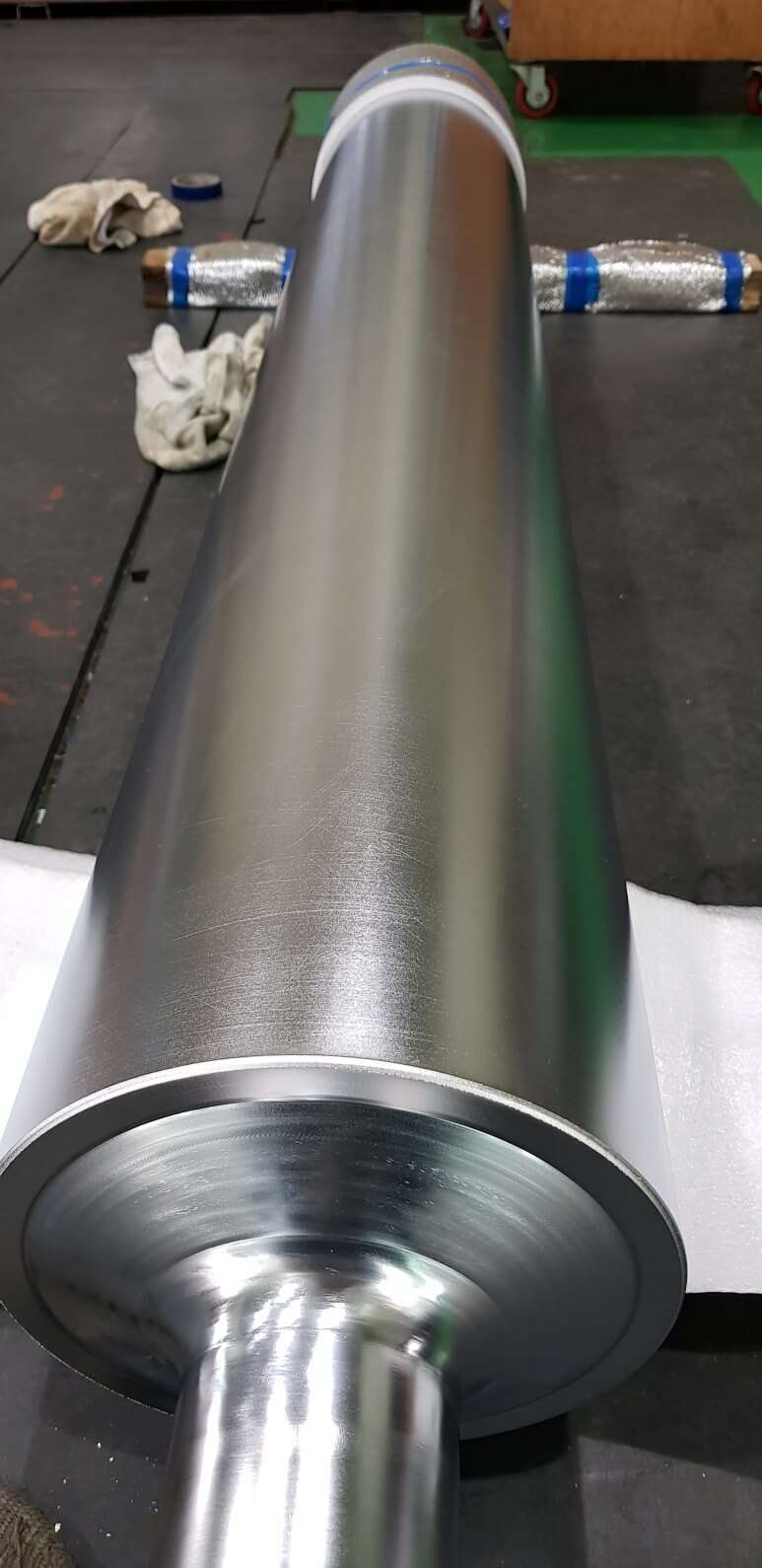
Color & Gloss Hard Chromium Plating:
Color: Bluish-white (steel blue), due to light scattering on the microcracked surface, producing a characteristic bluish brightness.
Gloss: High (reflectance > 65% at 550 nm wavelength), but decreases as thickness increases (>25 μm) due to surface cracking.
Research: Legg (2001) – Surface and Coatings Technology – gloss measured by 60° gloss meter: 800–1000 GU at <5 μm thickness, decreasing to <300 GU at >30 μm.
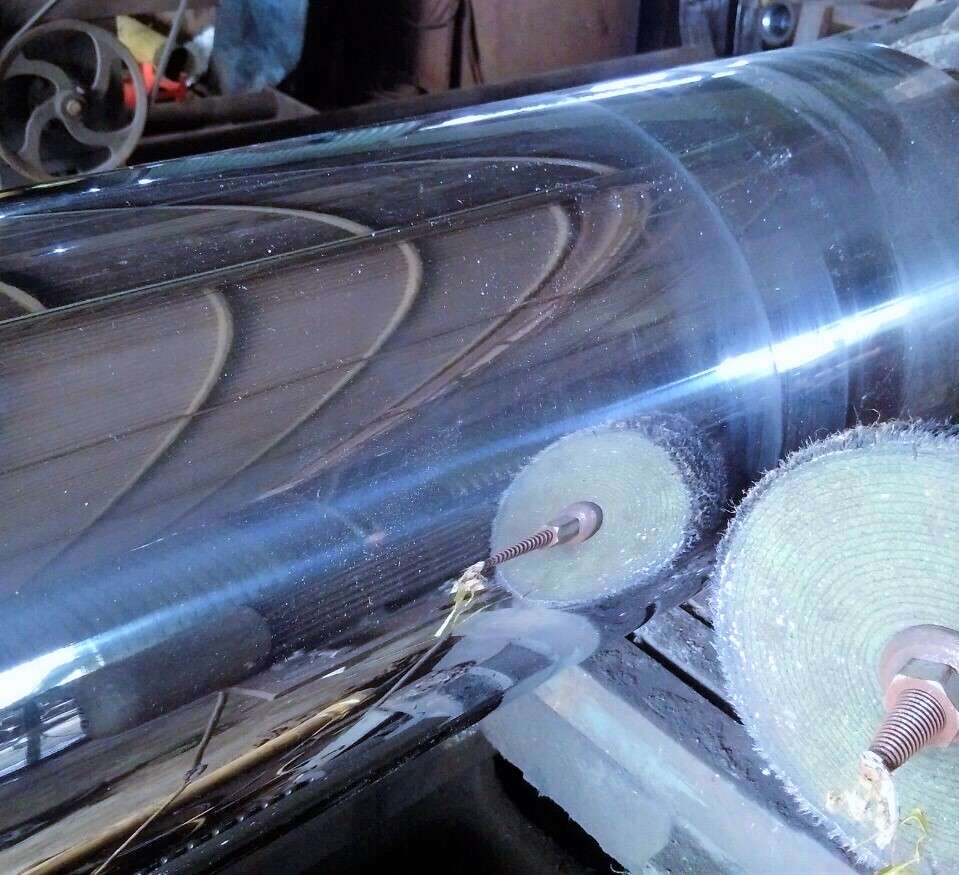
Mirror Finish: Ra < 0.001 µm when super-finished through precision polishing processes using specialized equipment from Thủy Lực Sài Gòn.
Chromium Alloy Plating:
Color: Darker (ash gray or gray-black) when alloyed with Ni, Co, W.
Gloss: Lower than pure chromium due to amorphous or nanocrystalline structure.
Research: Tsyntsaru et al. (2012) – Transactions of the IMF – Cr-W-C plating produces a matte black surface (<100 GU) but superior corrosion resistance.
Decorative Application: Decorative chromium (0.3–0.5 μm) plated over nickel → gloss >90%, bright white appearance.
Non-stick / Release Properties Hard Chromium Plating:
Static friction coefficient: 0.12 – 0.18 (vs. steel, with lubrication).
Low surface energy: ~35–40 mJ/m² → resists adhesion of polymers, rubber, plastics, food materials, paper pulp…
Research: Podgornik et al. (2005) – Wear – testing with EPDM rubber in injection molds showed a 70% reduction in release force compared to uncoated steel.
Mechanism: Microcracked surface creates “oil reservoirs” → hydrodynamic lubrication effect.
Chromium Alloy Plating:
Cr-WC, Cr-Diamond: Friction coefficient <0.1, superior anti-stick performance.
Research: Vernizy et al. (2019) – Journal of Materials Processing Technology – Cr + nano-diamond plating reduced PVC adhesion by 85%.
Industrial Applications: Plastic molds, pistons, steel rollers, plastic extrusion screws, hydraulic rods.

Microcracking & Lubrication Hard Chromium Plating:
Crack density: 300 – 1500 cracks/cm (depending on current density).
Crack depth: 5–15 μm, not penetrating the substrate (if coating thickness >50 μm).
Lubrication function: Cracks retain oil → form a continuous oil film → reduce friction and wear.
Research: Pina et al. (2000) – Surface and Coatings Technology – FEM simulation shows microcracks reduce contact stress by 40% and increase wear life by 3–5 times.
Applications: Bearing journals, shaft ends, high-speed rotating roller shafts.
Chromium Alloy Plating:
Cr-Co, Cr-Ni-P: No cracks or very low crack density (<50 cracks/cm).
Disadvantage: Poor oil retention → requires external lubrication.
Advantage: High-temperature resistance (>500°C), oxidation resistance.
Standard: MIL-R-46085 – requires a minimum of 250 microcracks/cm for self-lubricating coatings.

Advantages of Chromium Plating in Industry
2–3 times harder than hardened steel
Used for pistons, stamping dies
No pitting after 1,000 hours salt spray
Used for marine valves, oil pipelines
Microcracks retain natural lubrication
Used for rollers, molds
Thickness up to 0.5 mm
Used for shafts, bearings

Hard Chrome Plating Thickness Based on Scientific Research
Color retention over 500 hours salt spray
Used for: faucets, handles
Service life 3–5 times longer
Used for: motorcycle pistons, small shafts
Withstands over 1 million cycles
Used for: steel rollers, molds
Saves 70–90% cost
Used for: large shafts, industrial molds
SPECIAL MACHINING CAPABILITIES – HARD CHROME PLATING AT THUY LUC SAI GON
| Component Type | Maximum Size | Maximum Weight |
|---|---|---|
| Rolling Mill Rollers | Ø 3,000 mm × Length 3,200 mm | 7,000 kg |
| Tubular / Long Shafts | Ø 350 mm × Length 15 m | – |
| Brick Press Cylinders | Ø 2,200 mm × Length 1,500 mm | 7,000 kg |
| Tower Crane Rods | Ø 500 mm × Length 15 m | – |
| Plastic Film Rollers | Ø 750 mm × Length 4 m | 7,000 kg |
| Hydraulic Cylinder Barrels | Ø 3,000 mm × Length 4.5 m | 7,000 kg |
| Extrusion Screws | Ø 450 mm × Length 9 m | 7,000 kg |
| Flat Plates (Plating + Superfinishing) | Width 2.5 m × Length 4 m × Thickness 700 mm | – |
Special: Flat plates are finished with superfine grinding, achieving mirror-level reflectivity with surface roughness Ra ≤ 0.001 µm, suitable for high-end molds, printing, and medical applications.
Learn more: Hard Chrome Plating Products at Thuy Luc Sai Gon

10 Common Hard Chrome Plating Application Products
9-Step Hard Chrome Plating Process at Thuy Luc Sai Gon
Tolerance: ±0.02 mm.
Size range: Ø1500 – 7000 mm.
Higher grade: Ra ≤ 0.002 µm → mirror finish.
Improves adhesion of the plating layer to the base metal.
Creates an ideal base for chromium adhesion.
Ensures no peeling of the coating.
Coating thickness: adjusted by plating time (20–180 µm).
Accuracy: ±0.005 mm.
Ensures concentricity & cylindricity.
Inspection: Ra ≤ 0.001 µm (if required).
💰 HARD CHROME PLATING PRICE LIST
THUY LUC SAI GON
⚡ Reference price – Contact +84 903.863.762 for a quick quotation
1. Chrome Plating Price
| Thickness | Price | Application |
|---|---|---|
| 20–50 µm | 1,200–1,800 | Pistons, small shafts |
| 50–200 µm | 1,800–3,200 | Hydraulic rods, heavy duty |
| 200–800 µm | 3,200–6,500 | Large shaft restoration |
✅ Reference price based on surface area and part complexity.
2. Mold Chrome Plating
| Mold Type | Price | Surface Finish |
|---|---|---|
| Plastic molds | 45k–65k | Ra 0.05–0.1 µm |
| Stamping molds | 65k–95k | Ra 0.03–0.05 µm |
| Medical molds super mirror | 120k–180k | ≤ 0.001 µm |
✅ Includes polishing and surface inspection.
3. Hydraulic Rod Chrome Plating
| Diameter | Price / meter | Thickness |
|---|---|---|
| Ø50–Ø100 | 350k–550k | 60–80 µm |
| Ø100–Ø200 | 550k–850k | 80–120 µm |
| Ø200–Ø500 | 850k–1.5M | 100–180 µm |
✅ Concentricity inspection after plating.
4. Rolling Shaft Chrome Plating
| Size | Price | Application |
|---|---|---|
| Ø300–Ø800 Length ≤3m | 28k–35k | Steel rolling |
| Ø800–Ø1500 Length ≤6m | 35k–48k | Hot rolling |
| Ø1500–Ø3000 Length ≤15m | Contact | Large industrial shafts |
✅ Dimensional restoration ±0.01 mm.
🚛 GET A QUICK QUOTE
Call now: +84 903.863.762
Zalo: zalo.me/0903863762
⚡ Free consultation – Nationwide delivery
- VAT not included.
- Prices vary depending on thickness and dimensions.
- Discounts available for large orders.
- Lead time: 3–7 days.